What Is the Best Downy Mildew Chemical Control in 2026?
Choosing the best Downy Mildew Chemical Control in 2026 is not a matter of finding one “strongest” spray. The answer depends on crop, pathogen, local sensitivity, weather, and application timing. Downy mildew can spread quickly in humid conditions; pale, angular lesions and grayish growth beneath leaves may appear after infection is established. By then, a spray may protect new growth but cannot restore damaged tissue.
The Fungicide Resistance Action Committee’s 2025 Code List groups fungicides by mode of action and supports resistance-management planning. Its practical implication is clear: rotate effective modes of action, follow product labels, and avoid relying repeatedly on one group. Cornell plant pathologist Meg McGrath’s extension guidance emphasizes preventive timing and rotation; stated here as a paraphrase, her message is: “Protect plants early, and do not rely on one fungicide group.” Check crop-specific recommendations. A product effective on grapes may not be appropriate for cucumbers or onions.
This guide compares chemical options by crop fit, resistance risk, evidence, and application window—not by marketing claims. It also distinguishes protectants from products with limited post-infection activity. Results vary. A grower’s field notes, local extension alerts, and current product labels matter as much as a spray chart. FRAC guidance provides a resistance-management framework, not a universal prescription. The most defensible choice is the one supported by current local disease reports and registered crop directions. Even then, uncertainty remains: pathogen populations can shift, and field conditions rarely match trial conditions exactly.
How Downy Mildew Develops and Spreads
Downy mildew is caused by oomycetes, not true fungi. Infection often begins when spores land on wet, susceptible leaves. Mild temperatures and prolonged humidity help the pathogen grow inside leaf tissue. Look for angular yellow patches above, then gray-purple growth beneath leaves at dawn. It can be easy to miss. In cucurbits, the veins often limit each yellow patch, giving it a blocky outline.
Moisture drives the cycle: infected leaves produce spores, which wind can carry to nearby plants and, in some cases, farther afield. Rain splash and wet handling can also move spores through a crop.
UC IPM’s downy mildew guidance emphasizes leaf wetness and humid conditions, while Cornell Cooperative Extension’s grape disease guidance uses a crop-specific “10-10-10” warning: shoots around 10 cm long, temperatures at or above 10°C, and about 10 mm of rain. That is a warning, not a guarantee.
Host species and local weather change the risk, and a field can look healthy while infection is already developing. Check lower leaf surfaces and dense canopy areas after damp nights.
How to Confirm Downy Mildew Before Treatment
What Is the Best Downy Mildew Chemical Control in 2026?
How to Confirm Downy Mildew Before Treatment
Before choosing a treatment, check whether the symptoms fit downy mildew. Look for pale yellow or angular patches on upper leaf surfaces, often bounded by veins. Turn the leaves over. In damp weather, gray, white, or purplish growth may appear beneath the patches, especially early in the morning. Look closely. A single leaf is not enough; drought stress, nutrient problems, and other diseases can look similar.
Tips: Inspect several affected leaves from different parts of the plant. Note recent rain, humidity, and how quickly symptoms spread. Photograph both sides of a leaf, and avoid handling wet foliage between plants. These details can help a local agricultural extension specialist or diagnostic laboratory assess the problem.
Confirmation matters because downy mildew is caused by oomycetes, not true fungi, and look-alike diseases may need different management. If signs are unclear, seek a diagnosis before spraying. Not certain yet? Hold off. There is no single best chemical control for every crop or region. If treatment is warranted, choose only a product labeled for that crop and disease, and follow its directions and local guidance. Rotate different modes of action where labels allow; repeated use of the same type can encourage resistance. Even a careful diagnosis can be imperfect, so reassess new growth after treatment rather than assuming the first guess was right.
Which Fungicide Groups Target Downy Mildew in 2026
What Is the Best Downy Mildew Chemical Control in 2026?
Downy mildew is caused by oomycetes, not true fungi, so product choice matters. Fungicide groups commonly used against it include FRAC 4 phenylamides, 11 QoIs, 21 QiIs, and 40 CAA fungicides. Other options may include groups 27, 33, 45, and multi-site protectants such as copper compounds. Effectiveness depends on the crop, pathogen, and local resistance patterns. There is no single best group for every field.
Tips: Check the crop label and local guidance before spraying. Rotate different FRAC groups, rather than switching between products with the same group number. Apply protectants before infection when possible, and follow label intervals and rainfastness instructions. Inspect leaf undersides for pale, angular patches; they can appear before symptoms become obvious above.
Resistance can develop when one mode of action is used repeatedly. Group 4 resistance is a known concern in some downy mildew populations, and other groups can also lose performance. A spray plan may look tidy on paper, yet fail after wet nights and repeated exposure. That is worth admitting. Keep treatment records, scout after application, and seek local extension advice when control remains poor. Use only products registered for the crop and disease in your area.
How to Choose a Chemical Control for Your Crop
Choosing a downy mildew chemical control starts with the crop and the pathogen, not a product’s broad “fungicide” claim. Downy mildew is caused by oomycetes, and effective ingredients differ among crops and pathogen species. Check local disease alerts, inspect the undersides of leaves for angular yellow patches or gray growth, and confirm the diagnosis before spraying. Timing matters.
Use only products labeled for your crop and disease, then compare their modes of action. FRAC’s 2025 Code List places oomycete-active fungicides in several groups, including 4, 21, 40, and 49. These codes describe how ingredients act; they are not ratings of field performance. Rotate effective groups rather than repeating one mode of action. FRAC guidance for CAA fungicides, Group 40, limits consecutive use; check the current crop-specific recommendation and label for exact restrictions. Resistance can make a once-reliable option disappointing.
Weather and crop stage matter, too. A protective spray may perform differently after prolonged leaf wetness or heavy rain, while dense foliage can leave lower leaves untreated. Check coverage on both sides of the canopy, follow the label’s interval and rainfast instructions, and record what you applied. Even careful selection is not a guarantee. Reassess after treatment, especially if fresh lesions appear on new growth.
What Is the Best Downy Mildew Chemical Control in 2026?
How to use this chart: Resistance-risk classes are general categories, not efficacy ratings. The best option depends on the crop, downy mildew pathogen, local resistance patterns, and product registration. Follow the crop label and alternate effective fungicides with different FRAC codes; do not rely on one mode of action.
How to Apply Fungicides and Reduce Resistance Risk
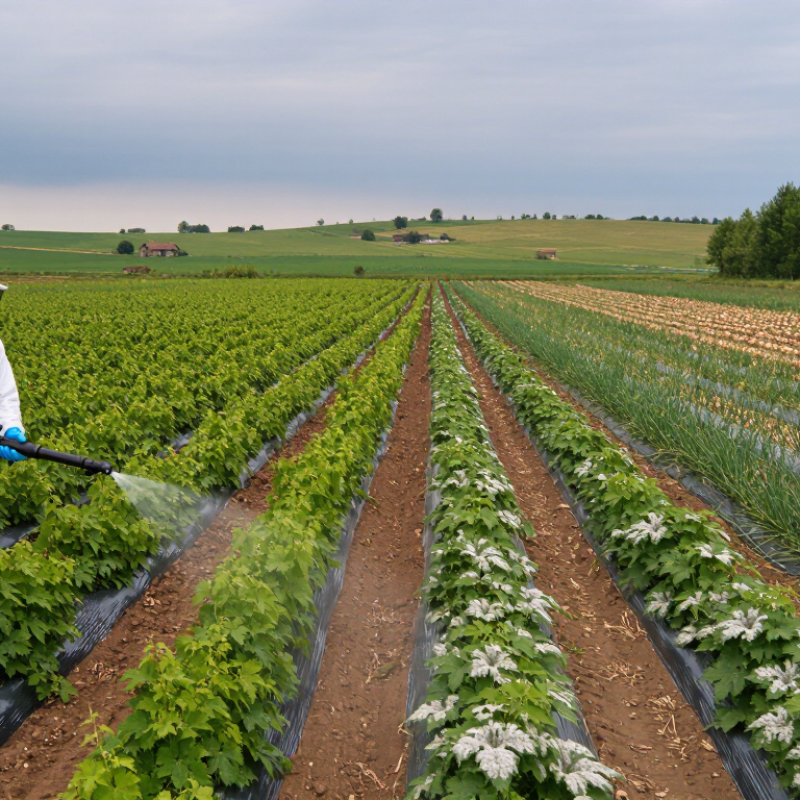
Effective downy mildew control starts before white or gray growth appears beneath leaves. Scout the canopy after humid nights, especially around shaded lower leaves. Apply only a locally registered fungicide for the crop and disease, following its label rate, interval, and preharvest instructions. Coverage matters: direct spray into the lower canopy, where droplets often miss. Use the label’s rainfast period as your guide. Fungicides generally protect healthy tissue; they may not restore leaves already badly infected.
Resistance planning matters as much as spray timing. The 2025 FRAC Code List assigns oomycete-active fungicide modes of action to groups including 4, 40, 43, and 49. Rotate among different FRAC groups, rather than merely changing product names, and follow group-specific limits on repeated applications. Where the label allows, combine a targeted fungicide with an effective multisite partner. Keep application records, including date, field, FRAC group, and disease pressure. That small habit can reveal overuse patterns. It is easy to miss one. Avoid spraying by calendar alone; inspect plants and use local disease forecasts. Still, forecasts are imperfect, and field conditions can shift overnight. Use resistant cultivars and airflow practices where practical, so chemical control carries less of the burden.