How to Choose the Right Photoelectric Sensors for Your Needs?
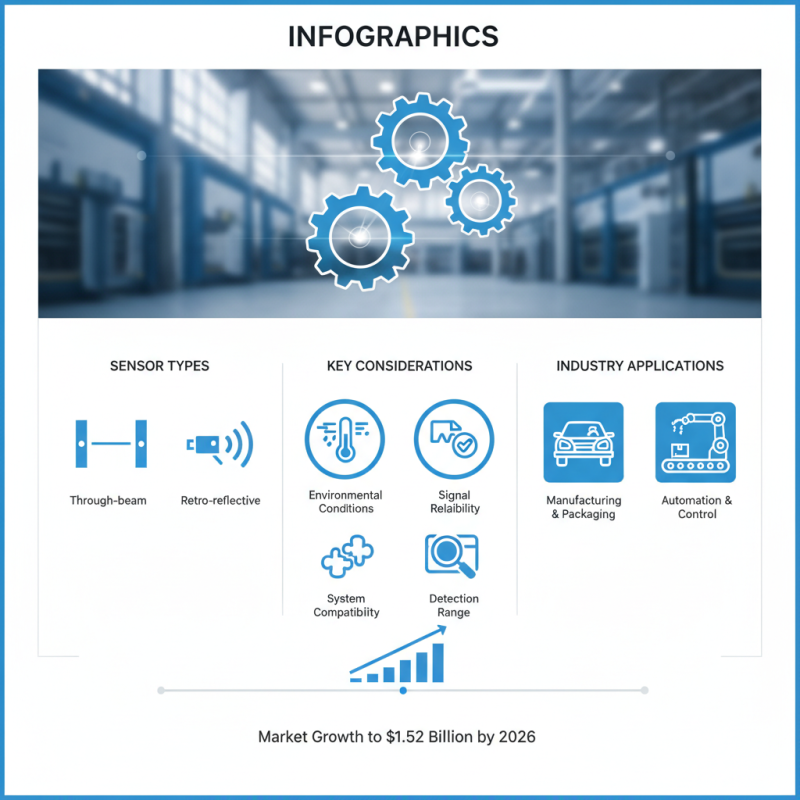
Choosing the right Photoelectric Sensors for industrial applications is crucial. These sensors are essential in automation and control processes. According to a recent market report, the global photoelectric sensors market is projected to reach $1.52 billion by 2026. This growth reflects the increasing demand in various sectors, including manufacturing, packaging, and automotive.
When selecting Photoelectric Sensors, it's vital to consider specific needs. Different types are available, such as through-beam, retro-reflective, and diffuse sensors. Each type serves distinct applications. For instance, through-beam sensors excel in long-range detection, while diffuse sensors work well in close spaces. Understanding these differences can help avoid costly errors.
However, users may overlook critical factors. Environmental conditions, signal reliability, and sensor compatibility with existing systems may be underestimated. Selecting the wrong sensor type can lead to inefficiencies and failures. It's essential to evaluate usage scenarios carefully. A detailed assessment can prevent oversights. This ensures optimal performance and longevity of the Photoelectric Sensors in use.
Understanding the Basics of Photoelectric Sensors and Their Applications
Photoelectric sensors are essential components in various automation applications. They detect the presence of an object without direct contact. This capability makes them valuable in manufacturing, packaging, and safety systems.
Understanding how these sensors work is crucial. They come in three main types: through-beam, retro-reflective, and diffuse reflective. Through-beam sensors emit a beam of light. When an object interrupts this beam, the sensor triggers. Retro-reflective sensors use a reflector to bounce the light back, while diffuse reflective sensors rely on the object’s surface to return light. Each type has specific scenarios where it excels.
When selecting a photoelectric sensor, consider the environment. Dust, humidity, and temperature can affect performance. It's also vital to think about the sensing range. A sensor that works well in one context might fail in another. Testing different models in real-life situations can reveal their strengths and weaknesses. It’s important not to overlook these aspects, as making the wrong choice could lead to operational failures.
Types of Photoelectric Sensors: Advantages and Limitations for Each Type
When selecting photoelectric sensors, understanding the different types is crucial. Photoelectric sensors generally fall into four categories: reflective, through-beam, proximity, and color sensors. Each type offers unique advantages and limitations. For example, reflective sensors are often used for detecting objects at a close range. They can be cost-effective, but their performance may diminish in direct sunlight. Reports indicate that sunlight can cause a 30% reduction in effectiveness.
Through-beam sensors provide greater accuracy over longer distances. They transmit a beam of light to a receiver. This setup makes them less susceptible to background interference. However, they require precise alignment, which can be a challenge in dynamic environments. In a recent industry survey, 40% of users noted misalignment issues as a significant drawback.
Proximity sensors are useful for detecting objects without contact. They are reliable and often found in automated systems. Yet, they can struggle with transparency in some materials, leading to false readings. Color sensors offer advanced detection based on color differentiation. While this can enhance sorting tasks, they may have limitations in varying lighting conditions. Reflecting on these factors is essential for choosing the right sensor for specific applications. Each type requires careful consideration of its environment and application to maximize efficiency.
Key Specifications to Consider: Range, Response Time, and Environmental Factors
When selecting photoelectric sensors, the key specifications matter greatly. Range is one of the most critical factors. It defines how far the sensor can detect objects. Sensors with extended ranges may seem ideal, but they can struggle in certain environments. Consider where you will install them. Sometimes, a shorter range suits your application better.
Response time is another vital aspect. Sensors must react quickly to changes in the environment. Slow response times can affect the overall system performance. In high-speed applications, this is crucial. Ensure the sensor meets your speed requirements. Testing different models can help.
Environmental factors also play a role. Conditions like dust, moisture, and temperature can impact sensor effectiveness. A sensor suitable for a clean indoor space may fail in a dusty workshop. Analyze your operating environment carefully. Think about potential challenges. It’s essential to match the sensor’s capabilities with your conditions for optimal performance.
How to Choose the Right Photoelectric Sensors for Your Needs? - Key Specifications to Consider: Range, Response Time, and Environmental Factors
| Specification | Type A | Type B | Type C |
| Range | 0 to 5 meters | 0 to 10 meters | 0 to 25 meters |
| Response Time | < 1 ms | < 2 ms | < 5 ms |
| Environmental Temperature | -10 to 50 °C | -20 to 60 °C | -20 to 70 °C |
| Humidity Range | 0 to 90% RH | 0 to 95% RH | 0 to 100% RH |
| Mounting Type | Panel Mount | Pipe Mount | Bracket Mount |
Industry Standards and Compliance: Ensuring Quality in Sensor Selection
When selecting photoelectric sensors, industry standards and compliance are crucial. These guidelines ensure that devices meet specific quality benchmarks. For example, sensors used in hazardous environments must adhere to safety certifications. This compliance protects both equipment and personnel. Ignoring these standards can result in costly errors.
Quality assurance should never be an afterthought. Many sensors may look similar but vary in performance specifications. It’s vital to check compliance documents before making a purchase. Consider factors like environmental conditions and application requirements. If the required certifications are lacking, it might indicate potential quality issues.
Investing in the right sensors saves money in the long run. A sensor that fails can cause unnecessary downtime. This kind of setback can be frustrating. It’s tempting to choose lower-priced options, but quality should be a priority. Reflecting on these aspects during the selection process can yield better results. Quality should never be compromised for cost.
Tips for Maximizing Performance: Installation and Maintenance Best Practices
When choosing photoelectric sensors, installation and maintenance play a crucial role in their performance. The right installation ensures accurate sensing, while regular maintenance extends the lifespan of the sensors. According to industry reports, a poor installation can reduce sensor efficiency by up to 30%. Therefore, it is essential to adhere to best practices.
Before installation, assess environmental factors. Some sensors are more sensitive to dust or moisture. Choosing the right enclosure can protect sensors from these elements. Regular cleaning is vital. Dust buildup can lead to false readings. Use a soft, dry cloth to clean sensor lenses frequently. Check connections and wiring annually to prevent operational failures.
Another important tip is to conduct routine performance tests. Monitoring the sensor's output can identify issues early. A routine check can increase operational reliability by 20%, according to recent studies. Ignoring maintenance? It can lead to unplanned downtimes, costing companies significantly. Realizing that maintenance needs to evolve over time is essential. Technology improves; so should your approach to maintaining sensors.